How to Get Maximum Value When You Flop a Set
Three solved flops show how pocket sevens on the button split checks, small bets and bigger bets after flopping a set when the big blind checks, and what those results cannot tell you.
Contents
In the solves below, the answer is to bet. With 77 on the button, after the big blind calls preflop and checks a flop that gives you a set, the solver checks 0.0% of the time on Qs 7h 2d, 10.4% on 9s 8s 7h, and 3.2% on 7s 6h 5h.
The small bet, a third of the pot, is the most common action on all three boards. The bigger bet gets much more weight on the two connected, two-tone boards than on the dry one. The rest of this page shows those splits, what changes between the boards, and how far the results can be trusted.
The spot
Every number here comes from one setup: 6-max cash, 100 bb stacks, the button opens to 2.5 bb, and the big blind calls. The flop pot is 5.5 bb with 97.5 bb behind. The big blind checks, and the button acts.
On all three boards the big blind checks nearly its whole range first, so the button facing a check is the usual way this flop starts in these solves.
The button can bet 33% or 75% of the pot. The solver's screens and CSV files show those sizes as 2 bb and 4 bb, so this page uses those labels.
These are averages for the 77 hand class. Each board has one seven on it, so only 3 of the 6 pocket-seven combinations are still possible. The numbers cover those three together. They do not describe a particular pair of sevens, and this page has no data on how individual combinations differ.
What 77 does on each board
| Action | Q♠ 7♥ 2♦ | 9♠ 8♠ 7♥ | 7♠ 6♥ 5♥ |
|---|---|---|---|
| Check | 0.0% | 10.4% | 3.2% |
| Bet 2 bb | 74.1% | 48.7% | 60.9% |
| Bet 4 bb | 25.9% | 40.9% | 35.8% |
| Bet 97 bb | 0.0% | 0.0% | 0.0% |
The 97 bb bet stays in the tree. Its 77 frequency is zero in the CSV on all three boards, which is not a claim that the action is impossible.
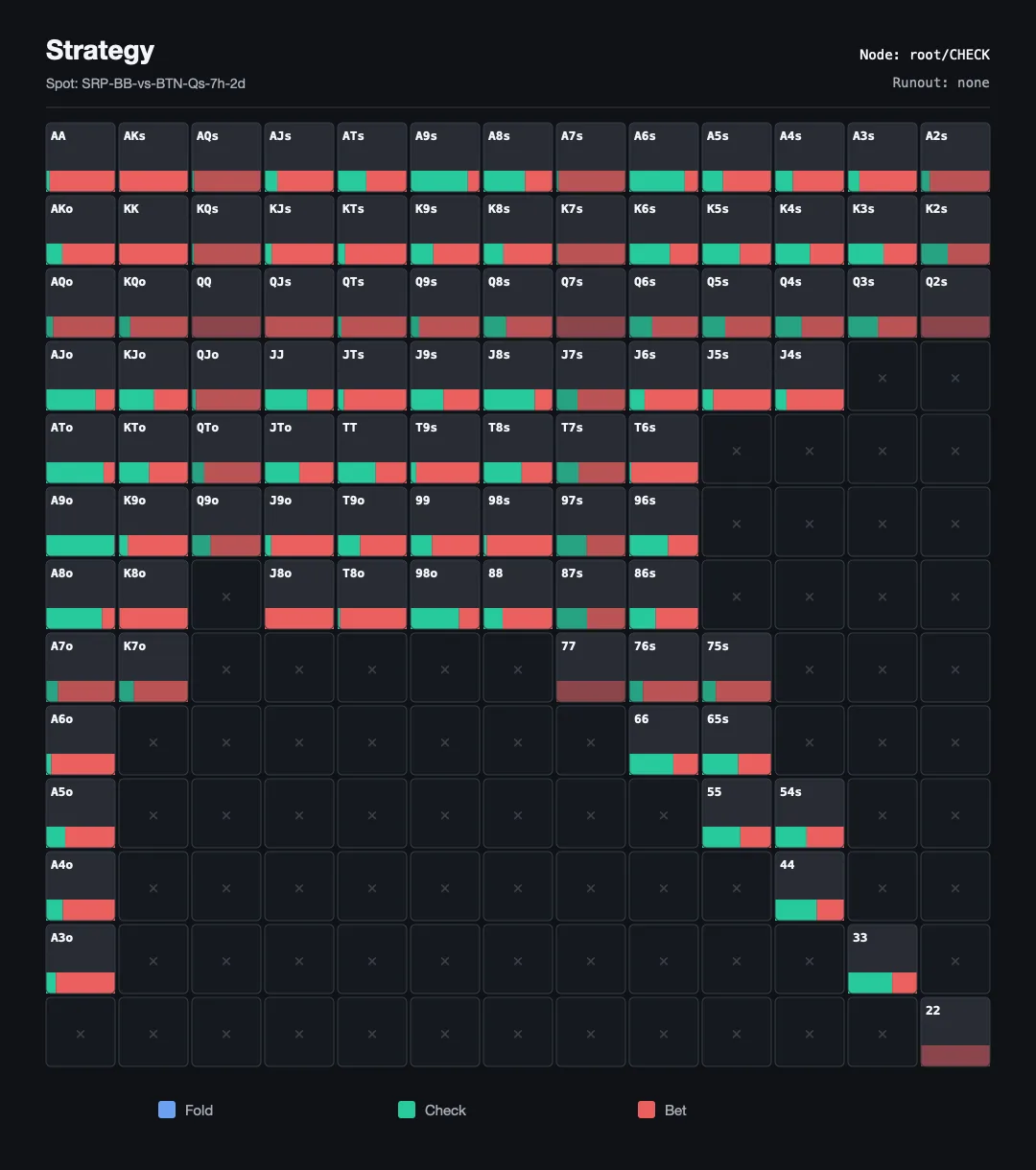
Qs 7h 2d: never checked, mostly the small bet
77 has middle set on a dry, rainbow board. In this solve it is never checked: 0.0%. It bets 2 bb 74.1% of the time and 4 bb 25.9%.
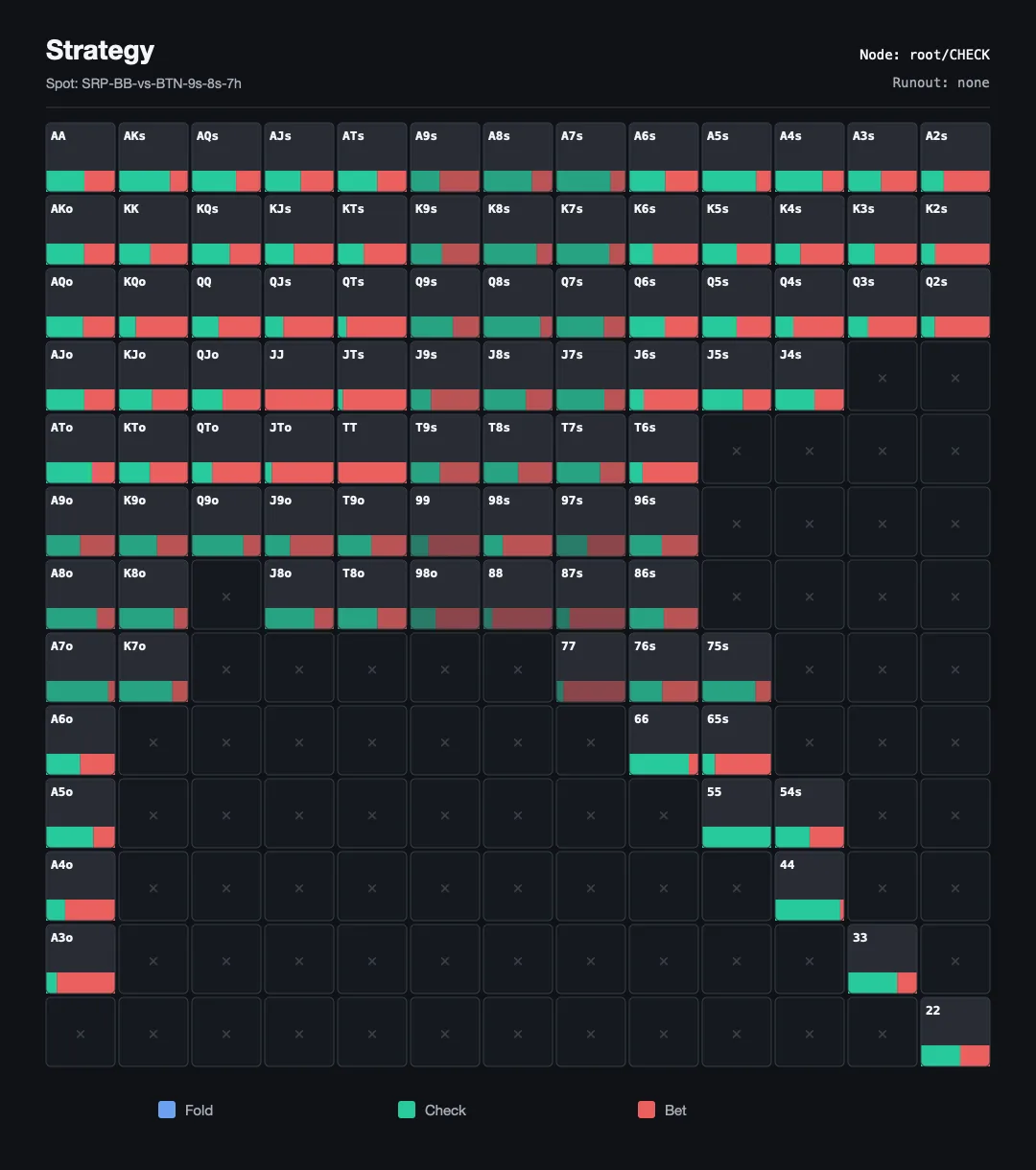
9s 8s 7h: the most checks, and more of the bigger bet
77 has bottom set. The board is connected and has two spades, so straight and flush draws are possible. This is the board where 77 checks most often, at 10.4%. The 2 bb bet is still the most common action, at 48.7%, and the 4 bb bet rises to 40.9%.
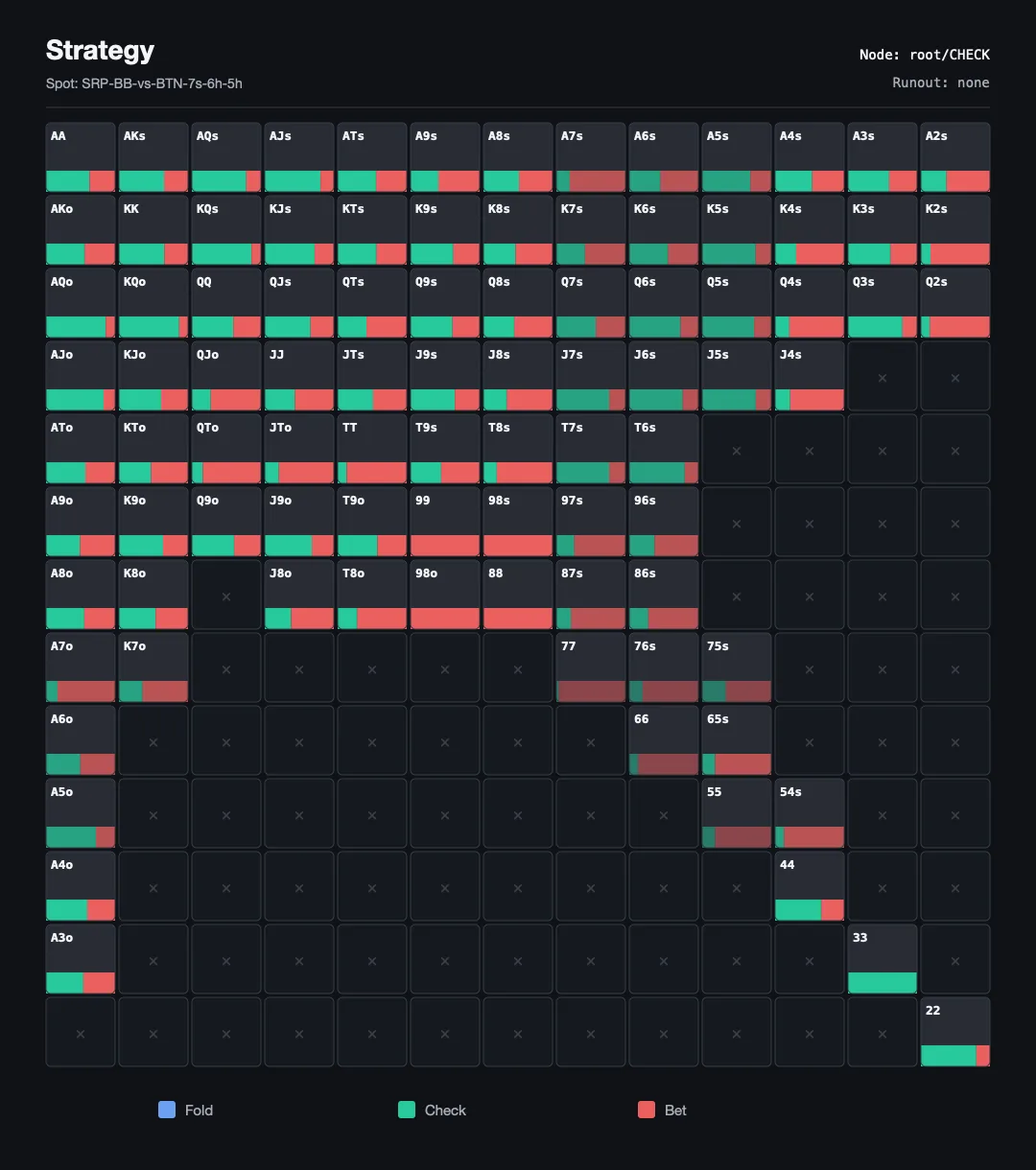
7s 6h 5h: top set, more of the bigger bet than on the queen-high board
77 has top set on a low, connected board with two hearts. It checks 3.2% of the time. It bets 2 bb 60.9% and 4 bb 35.8%, so the bigger size is used more than on Qs 7h 2d.
Does the whole button range keep betting?
No, not to the same degree. The button's whole range checks more often on 9s 8s 7h and 7s 6h 5h than on Qs 7h 2d. On those two connected boards, the button checks back more of its range while 77 is still bet most of the time.
That statement, and the earlier one about the big blind checking nearly its whole range, are calculated from the CSV files in this study, not read from the solver's screen. Each hand class's frequency is multiplied by the number of combinations still possible on that board, once without preflop weights and once with them. Both methods point the same way. The percentages shown on the app's own overall display do not include preflop weights, so they are not the same measure.
Why you can't name one cause
It is tempting to say "bottom set checks more" or "top set bets bigger." These results don't show that. From one board to the next, the board's texture and the rank of the set (middle, bottom, top) change at the same time, along with how both ranges connect with the flop. Treat the three boards as representative examples, not as an experiment that isolates one variable.
For the same reason, a new board is a new question. If you flop a set on a board that isn't listed here, this page does not give you its frequencies.
How to use this in your study
Use it to review hands after a session. It is study material, not assistance for decisions while you are playing.
- Confirm the spot first. These numbers need the same positions, preflop action, stacks, ranges, and bet sizes.
- Check how often you check back a set here. On these three boards the solver rarely does. If you often do, these solves are evidence that the choice is worth reviewing.
- Look at your sizes, not just whether you bet. A single bet frequency hides how much of it goes to 2 bb and how much to 4 bb, and that split moves between these boards.
- Compare a new board to these three, then solve it if it matters. The comparison gives you a question to investigate, not a frequency to copy.
If mixed frequencies are new to you, start with What Is GTO in Poker?. For the same spot when the button misses the flop, see How to Play AK When You Miss the Flop. The glossary defines terms such as range and EV.
What this doesn't cover
These solves only cover the button's first decision on the flop, in position, after a single raised pot and a big blind check. They don't cover what happens after the big blind raises, the turn or the river, or playing a set out of position. They also don't cover 3-bet pots, other stack depths, or multiway pots. Each of those is a different model, so don't carry these frequencies over to them. Nor do they settle whether slowplaying a set is right in general: they only show how often 77 is checked in these three solves.
Inputs and results
Downloads
- Qs 7h 2d: node CSV (10,040 bytes) and setup record (5,644 bytes).
- 9s 8s 7h: node CSV (10,003 bytes) and setup record (5,644 bytes).
- 7s 6h 5h: node CSV (9,993 bytes) and setup record (5,644 bytes).
- Download MelaGTO Direct v1.1 (10).
Each CSV has 92 BTN hand classes for the node after the big blind checks, with frequencies as 0–1 fractions and action EVs in bb. It is not a complete tree or a per-combination result.
The setup records were not written by the app. Before these solves we read both ranges back again from Direct's Bulk edit fields and checked the tree settings by eye in its setup screens; they matched the setup used for the AK article. Each record is that article's setup record with only the board changed, in the app's setup format. The thread count, print interval, and isomorphism switch are not shown in the interface, so they carry the source code's default values.
| Setting | Value used |
|---|---|
| Solver | MelaGTO Direct v1.1 (10), CPU, FP32, customExact, English interface |
| Flop sizes | Bets 33% and 75% of the pot, shown as 2 bb and 4 bb; raises 50%; the big blind may lead |
| Turn and river sizes | Bets and raises 50% of the pot; no big blind donk bets |
| Raises | Raise cap 2, which counts the bet itself, so one raise is allowed after a bet |
| All-in | Enabled, threshold 67% |
| Stop configuration | maxIteration 100; 0.5% of pot accuracy target |
| Source default values | Threads automatic (-1); isomorphism enabled |
| Rake | Unknown and not modeled: this is a local postflop model with no deduction, and it does not claim to reproduce any site's rake |
Convergence is unknown. The 0.5% target is a setting, not a result. The capture exposes neither a final iteration count nor measured exploitability, so we don't claim the target was reached or that these are complete equilibria. Observed completion took at most 196 seconds on Qs 7h 2d, 123 seconds on 9s 8s 7h, and 129 seconds on 7s 6h 5h. Those are upper bounds from when completion was first seen, not exact solve times.
Ranges used
These are the 6max_RC_100bb_200NL ranges, artifact version 2026.08.12-v1, with their mixed weights, as read back from Bulk edit. A class with no number has weight 1; unlisted classes have weight 0.
BB, out of position (90 classes)
ATs:0.949,A9s,A8s,A7s,A6s,A5s:0.03,A4s:0.366,A3s:0.917,A2s,KJs:0.699,KTs:0.521,K9s,K8s,K7s:0.829,K6s:0.801,K5s:0.978,K4s:0.967,K3s:0.675,K2s:0.896,AQo:0.238,KQo:0.639,QJs,QTs:0.68,Q9s:0.771,Q8s:0.885,Q7s:0.952,Q6s:0.922,Q5s:0.767,Q4s:0.903,Q3s:0.752,Q2s:0.673,AJo:0.765,KJo:0.584,QJo:0.75,JTs:0.567,J9s:0.169,J8s:0.922,J7s:0.414,J6s:0.702,J5s:0.498,J4s:0.605,J3s:0.577,J2s:0.259,ATo:0.833,KTo:0.643,QTo:0.709,JTo:0.758,T9s:0.116,T8s:0.599,T7s:0.79,T6s:0.479,T5s:0.275,A9o:0.844,K9o:0.711,Q9o:0.889,J9o:0.845,T9o:0.866,99:0.588,98s:0.742,97s:0.925,96s:0.9,A8o:0.935,K8o:0.341,T8o:0.301,98o:0.082,88:0.814,87s:0.693,86s:0.824,85s:0.808,A7o:0.723,87o:0.019,77:0.887,76s:0.63,75s:0.969,74s,A6o:0.375,66:0.902,65s:0.58,64s,63s:0.688,A5o:0.765,55:0.909,54s:0.504,53s,52s:0.592,A4o:0.575,44,43s,33,22
BTN, in position (92 classes)
AA,AKs,AQs,AJs,ATs,A9s,A8s,A7s,A6s,A5s,A4s,A3s,A2s,AKo,KK,KQs,KJs,KTs,K9s,K8s,K7s,K6s,K5s,K4s,K3s,K2s,AQo,KQo,QQ,QJs,QTs,Q9s,Q8s,Q7s,Q6s,Q5s,Q4s,Q3s,Q2s:0.629,AJo,KJo,QJo,JJ,JTs,J9s,J8s,J7s,J6s,J5s,J4s:0.974,ATo,KTo,QTo,JTo,TT,T9s,T8s,T7s,T6s,A9o,K9o,Q9o,J9o,T9o,99,98s,97s,96s,A8o,K8o:0.923,J8o:0.526,T8o:0.929,98o:0.32,88,87s,86s,A7o,K7o:0.247,77,76s,75s,A6o,66,65s,A5o,55,54s,A4o,44,A3o:0.84,33,22:0.692
To rerun a board in Direct, create a Custom spot with the settings above, paste both ranges with Bulk edit, choose CPU solving, and compare the node after the big blind checks with the downloaded CSV. Version, hardware, and stopping conditions can all affect an exact rerun.
GTO fundamentals · Explainer · 2026-11-04
What Is GTO in Poker? A Practical Explanation
An introduction to game theory optimal poker, ranges, mixed actions, and the limits of one declared solver example.
⏱ 6 min read
Beginner questions · Beginner question · 2026-11-04
How to Play AK When You Miss the Flop
Three solved flops show how AKo on the button divides checks, small bets and bigger bets after the big blind checks, and what those results cannot tell you.
⏱ 8 min read